2025 brought a genuine return of activity to the Lebanese market, with transaction volumes climbing and prices in Beirut's strongest neighborhoods beginning to firm up after a long correction. The renewed conflict pressure of early 2026 has since cooled the pace again, and cadastral figures show transactions well down year on year in the first quarter, a reminder that this market moves in cycles shaped as much by regional events as by fundamentals.
What hasn't changed is the underlying logic that keeps Lebanese buyers, and the diaspora, coming back to property: with the banking sector still constrained and the lira's history still fresh, a well-chosen home or plot remains the most trusted way to hold value in the country. That single fact continues to drive demand even in the quieter quarters.
Achrafieh & the Beirut core: Urban safe haven
Construction permits have slowed for years, so well-kept, modern units in Achrafieh are becoming a genuinely finite asset. It draws young professionals, medical staff near the hospitals, and returning diaspora who want walkability and security. Buildings with their own solar power and water systems are pulling ahead, infrastructure independence has become a selling point in its own right. As the core fills up, the search is spilling into Nahr and Gemmayze Pasteur, where value is still to be found.
Byblos & the coast: Heritage & sea
Byblos still holds some of the country's most characterful homes, tall, storeyed houses locally called harat, with rustic wood shutters and exposed beams. Along Jounieh Bay and in Batroun, houses tend to sit lower and quieter, built to blend into the coastline rather than dominate it. It's a market for buyers who want proximity to the sea without losing the texture of an older Lebanon.
Mount Lebanon villages: Restoration & land
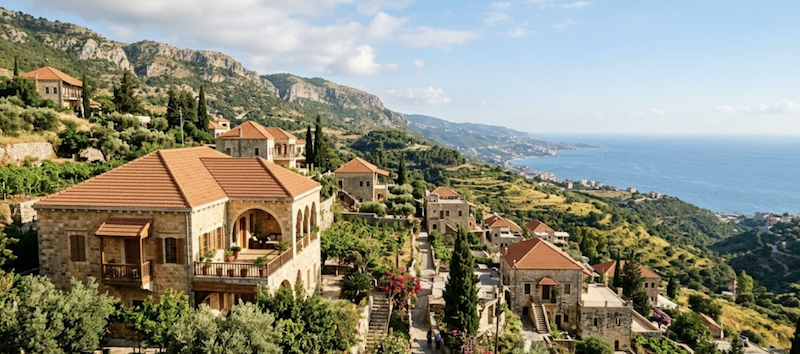
The mountain villages, Bekfaya, Dhour Chweir, Bologna, Baskinta, Broumana, Beit Meri, the Chouf, Faqra and Kfardebian, are where the restoration wave is most visible. Since roughly 2018, a returning generation of the diaspora has been steadily bringing old stone houses back to life, orchard plots and all. It's slower-moving, land-driven buying, and increasingly the most emotionally significant kind.
Lebanon has no official published land-price index, so figures move with every broker and every wadi. What follows are indicative ranges drawn from current listings and market reports, region by region, useful for orientation, not for pricing a specific plot.
> Akkar & North Tripoli from $80 – $400
> Batroun from $200 – $900
> Byblos (Jbeil) from $300 – $1,100
> Keserwan (Jounieh–Adma) from $600 – $2,000
> Beirut & inner suburbs from $1,500 – $5,000
> Metn (Broumana, Baabdat) from $500 – $1,800
> Baabda from $700 – $1,500
> Faqra & Kfardebian from $1,500 – $4,500
> Chouf & Aley from $200 – $600
> South (Saida, Tyre, Nabatiyeh) from $100 – $400
> Bekaa Valley (Zahle, West Bekaa) from $5 – $850
Figures are USD per square meter of land, indicative as of mid-2026. Coastal and city plots swing hardest with zoning and sea view; Bekaa figures reflect largely agricultural land.
19th-century stone houses brought back with what designers are now calling "layered authenticity", original arches and woodwork left exposed, furnished with contemporary pieces rather than period reproduction.
Units under 120 square meters, well-located and efficiently laid out, are outperforming larger, older stock, a direct response to construction costs and a more cautious buyer.
Privacy-conscious buyers, especially returning diaspora, are increasingly transacting quietly, off-market, through trusted introductions rather than public listings.
In Achrafieh especially, one and three-bedroom units built for short-term letting are seeing strong occupancy, turning a home purchase into an income-producing asset too.
Why an old Lebanese house feels like home before you've even moved in.
Every culture has a version of the house that people are homesick for. In Lebanon, it's the "dar", the central-hall house with its cube of stone, its triple arch open to the valley, and its red-tiled roof that villagers still call the tarboush, the fez, worn with a certain pride by whoever owned the house beneath it.
The arch was never just an entrance. It was an invitation, the house saying come in, sit, stay a while.
Everything about the design was built around gathering people, not just sheltering them. The dar itself, the central hall, was the room the whole household moved through, welcoming guests, sharing meals, telling the day's news. Thick stone walls kept it cool through the summer and held warmth through the winter, so the house itself did the work of making people comfortable, long before anyone thought to call that hospitality.
* The triple arch frames the view and the light, so the room is never sealed off from the mountain or the sea outside it.
* The courtyard, citrus trees, a fountain, room to sit outdoors, turns the home's edge into another place to gather.
* The stonework, cut and fitted by hand, needed no ornament to prove the skill behind it.
* The tarboush roof has no windows or chimney, only the quiet dignity of a house that's been lived in properly.
This is the thing new construction rarely manages to replicate: a house designed for people to be together in it. That's why a restored dar in the mountains, or a heritage villa in Byblos, tends to hold a different kind of value than a new apartment with a better view, it isn't just a place to live, it's a place where warmth was built into the walls on purpose. Buy one, and you're not just buying square meters. You're buying back a version of home where the door was always meant to be open.
Occa curates a private selection of off-market homes across Lebanon, from restored heritage houses to quiet coastal land.
Reach out to see what's currently available.
